
A campaign has been set up in protest about the cuts in science research funding. Often the output from research seems very academic and unrelated to real life, but there are many benefits to maintaining our strong scientific research community in the UK. The points are explained very clearly on the website, so I won't reiterate them here.
Please take a few minutes to look at this website: http://scienceisvital.org.uk/
Thursday, 30 September 2010

Friday, 24 September 2010
The psychology of face processing...
There have been a couple of interesting pieces in the news about face processing recently.
The BBC have given a fair amount of coverage to the cabbage head e-fit and have an article about why it is difficult to create an accurate e-fit of a person.
In the Daily Mail, Prof Dave Perrett, on of the leading experts on face processing, has written a great article on facial attractiveness.
Alternatively - there is this wonderful book on face processing ;)
The BBC have given a fair amount of coverage to the cabbage head e-fit and have an article about why it is difficult to create an accurate e-fit of a person.
In the Daily Mail, Prof Dave Perrett, on of the leading experts on face processing, has written a great article on facial attractiveness.
Alternatively - there is this wonderful book on face processing ;)
Friday, 13 August 2010
New website...
Sorry for the lack of recent blogging activity.
We've just uploaded our newly redesigned website. Check it out at www.statsART.com
Let us know what you think of it!
We've just uploaded our newly redesigned website. Check it out at www.statsART.com
Let us know what you think of it!
Thursday, 8 July 2010
Once again, correlation does not imply causation...
An interesting piece of research has been reported on by the BBC today.
The research looked at the relationship between inactivity and obesity. Most previous research has either assumed or shown the inactivity leads to obesity.
In contrast, this new research suggests that the direction of the relationship is the other way around - obesity leads to inactivity.
This is a nice example of the "correlation does not imply causation" mantra and presents a nice chicken and egg situation.
The original study can be found here.
The research looked at the relationship between inactivity and obesity. Most previous research has either assumed or shown the inactivity leads to obesity.
In contrast, this new research suggests that the direction of the relationship is the other way around - obesity leads to inactivity.
This is a nice example of the "correlation does not imply causation" mantra and presents a nice chicken and egg situation.
The original study can be found here.
Wednesday, 7 July 2010
How big is big?
Another great article on the BBC website by Michael Blastland in the Go Figure series.
In this feature he talk about how was assess how "big" a number is.
In this feature he talk about how was assess how "big" a number is.
Tuesday, 29 June 2010
Do I look fat in this???
Lots of papers have reported a recent piece of research with headlines such as:Why women think they are fat: brain 'thinks body is two thirds bigger than it is'
This is a perfect example of journalists taking the findings of a good study and drawing conclusions about twenty squillion miles ahead of the what the study actually did and found.
The study asked participants to estimate the location of 10 different points on their hands and found that the participants overestimated these locations.
The key thing to notice is that the research only looked at the estimation of hands. The newspapers are reporting as if the study looked at the entire body, but this is not the case at all.
In fact, the logical conclusion of the study actually would be the exact opposite of the interpretation of the newspapers. The authors explain their results with reference to the homunculus. The parts of our brain that feel the sensations from the entire body and control our motor movements are not proportionately related to the parts of the body. You can see this clearly in a picture of the homunculus.
Large parts of our brain are dedicated to the hands, face and mouth. The torso and legs are represented by far smaller parts. This is why the authors claim that the hands are overestimated - because they are over represented in the brain. By this logic, the shoulders, trunk, hips and legs should be underestimated - certainly not overestimated!!! If anything - this research would predict that when a woman thinks about her body she would think that she's smaller than she really is.
Another error in the reporting - they got the name of the lead researcher wrong. This work was conducted by Matthew Longo, not Michael as the papers call him!!!
This is a perfect example of journalists taking the findings of a good study and drawing conclusions about twenty squillion miles ahead of the what the study actually did and found.
The study asked participants to estimate the location of 10 different points on their hands and found that the participants overestimated these locations.
The key thing to notice is that the research only looked at the estimation of hands. The newspapers are reporting as if the study looked at the entire body, but this is not the case at all.
In fact, the logical conclusion of the study actually would be the exact opposite of the interpretation of the newspapers. The authors explain their results with reference to the homunculus. The parts of our brain that feel the sensations from the entire body and control our motor movements are not proportionately related to the parts of the body. You can see this clearly in a picture of the homunculus.
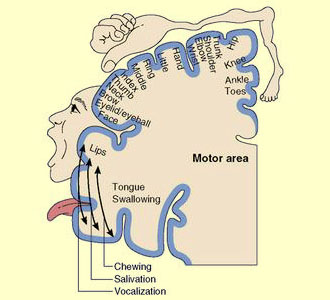
Large parts of our brain are dedicated to the hands, face and mouth. The torso and legs are represented by far smaller parts. This is why the authors claim that the hands are overestimated - because they are over represented in the brain. By this logic, the shoulders, trunk, hips and legs should be underestimated - certainly not overestimated!!! If anything - this research would predict that when a woman thinks about her body she would think that she's smaller than she really is.
Another error in the reporting - they got the name of the lead researcher wrong. This work was conducted by Matthew Longo, not Michael as the papers call him!!!
Monday, 28 June 2010
Vader - BPD or not?
Subscribe to:
Posts (Atom)