
Long time, no blog...
An AMAZING Horizon program on the nature of scientific debate and the representation of science in the media. An absolute must watch!!!
Tuesday, 1 February 2011

Wednesday, 8 December 2010
The Joy of Stats...
There was a great program last night on BBC 4 on The Joy of Stats. It was a great overview of the history of statistics and how they are relevant and used in current research.
Continuing with the stats theme, the new series of More or Less starts on Radio 4 this Friday (10th), and Lady Tasting Tea is a great book on the history of statistics and the key people involved in developing this field.
Continuing with the stats theme, the new series of More or Less starts on Radio 4 this Friday (10th), and Lady Tasting Tea is a great book on the history of statistics and the key people involved in developing this field.
Friday, 3 December 2010
Finger length is associated with EVERYTHING...
There seems to regularly be reports in the media of a new studying showing something to do with finger length and illness, psychological disorders, personality, sexuality, the list goes on... The Daily Mail have even attempted to provide a summary of what this is all about!!! And obviously the responses are full of "rubbish" and "why is our money wasted on this research"...
So what is this all about?
First, it is not actually finger length, it is the relative lengths of the index and ring fingers. If the index finger is shorter than the ring finger, this indicates a more "masculine" 2D:4D.
Second, digit ratio (as it is properly called) is certainly not going to "cause" any kind of illness, personality or any other psychological trait. Instead, digit ratio and all of these "outcomes" are associated with a third variable - prenatal testosterone exposure.
Levels of testosterone prenatally are associated with determining the relative lengths of the fingers, and potentially in a great number of different psychological and medical outcomes. So if someone has high levels of prenatal testosterone exposure, they are likely to have more masculine traits and may be at risk of some illnesses associated with higher levels of testosterone.
Before dismissing the relationship between prenatal testosterone and digit ratio, there is very strong evidence to support this relationship. One study measured levels of testosterone from amniotic fluid and found that, in later life, that children with higher levels of prenatal testosterone had more masculine digit ratios (Lutchmaya et al., 2004). Two other studies artificially manipulated prenatal hormonal levels in rats, and found that digit ratio changed accordingly (Talarovicova et al., 2009; McMechan et al., 2004).
So there is not a relationship between finger length and cancer/personality/sexuality/etc. They have the same causal factor.
It is also really important to remember that having a particular digit ratio will not 100% predict a particular illness or personality, it might just indicate an increased risk factor. Just like obesity increases the risk of various illnesses, but it does not totally determine or predict the illness, and people who are not obese might also develop the illness.
Similarly, the levels of prenatal testosterone exposure are not the only determiner of digit ratio. Many other factors are likely to be involved, but there is a clear and reliable relationship between levels of prenatal testosterone and digit ratio. Other factors under examination includes the functioning of hormone receptors (meaning some people may be more sensitive to, or absorb more, testosterone) and the relative exposure to testosterone in relation to other hormones, particularly oestrogen.
Rant over - thanks!!!
So what is this all about?
First, it is not actually finger length, it is the relative lengths of the index and ring fingers. If the index finger is shorter than the ring finger, this indicates a more "masculine" 2D:4D.
Second, digit ratio (as it is properly called) is certainly not going to "cause" any kind of illness, personality or any other psychological trait. Instead, digit ratio and all of these "outcomes" are associated with a third variable - prenatal testosterone exposure.
Levels of testosterone prenatally are associated with determining the relative lengths of the fingers, and potentially in a great number of different psychological and medical outcomes. So if someone has high levels of prenatal testosterone exposure, they are likely to have more masculine traits and may be at risk of some illnesses associated with higher levels of testosterone.
Before dismissing the relationship between prenatal testosterone and digit ratio, there is very strong evidence to support this relationship. One study measured levels of testosterone from amniotic fluid and found that, in later life, that children with higher levels of prenatal testosterone had more masculine digit ratios (Lutchmaya et al., 2004). Two other studies artificially manipulated prenatal hormonal levels in rats, and found that digit ratio changed accordingly (Talarovicova et al., 2009; McMechan et al., 2004).
So there is not a relationship between finger length and cancer/personality/sexuality/etc. They have the same causal factor.
It is also really important to remember that having a particular digit ratio will not 100% predict a particular illness or personality, it might just indicate an increased risk factor. Just like obesity increases the risk of various illnesses, but it does not totally determine or predict the illness, and people who are not obese might also develop the illness.
Similarly, the levels of prenatal testosterone exposure are not the only determiner of digit ratio. Many other factors are likely to be involved, but there is a clear and reliable relationship between levels of prenatal testosterone and digit ratio. Other factors under examination includes the functioning of hormone receptors (meaning some people may be more sensitive to, or absorb more, testosterone) and the relative exposure to testosterone in relation to other hormones, particularly oestrogen.
Rant over - thanks!!!
Thursday, 2 December 2010
Science journalism...
Usually I'm somewhat critical of science journalism - but this article is 100% perfection!!! A great parody from The Lay Scientist.
Tuesday, 23 November 2010
Gender and development...
The BBC have examined a really interesting case study of a boy who was brought up as a girl.
It is often difficult to distinguish between genetic/biological and environmental influences, but the child had a twin brother - possibly the best control participant ever!
It is often difficult to distinguish between genetic/biological and environmental influences, but the child had a twin brother - possibly the best control participant ever!
Tuesday, 16 November 2010
Statistical happiness???
With the government announcing that it will start to measure the nation's happiness and wellbeing, the latest Go Figure article by Michael Blastland looks at some of the problems with this analysis. Obviously the "correlation does not imply causation" mantra returns...
Monday, 15 November 2010
Real time world statistics...
Worldometers is a great site showing real time changes in global statistics to do with world population, society and media, food, health, energy and a lot more. Very interesting, quite mesmerising, but slightly scary in places.
Monday, 8 November 2010
Psychological Medicine...
The journal Psychological Medicine is celebrating its 40th birthday. As part of this they are making the most read paper from each year freely available until the end of this year.
There really is a wide range of papers discussing many psychological disorders. It's particularly interesting to see how views and perspectives have changed since 1970.
There really is a wide range of papers discussing many psychological disorders. It's particularly interesting to see how views and perspectives have changed since 1970.
Wednesday, 27 October 2010
The psychology of rollercoaster rides...
Apparently the worlds fastest rollercoaster is about to open up in Abu Dhabi's Ferrari World.
This BBC article gives some interesting insights into the psychology of why people enjoy, and can become addicted to, rollercoasters.
This BBC article gives some interesting insights into the psychology of why people enjoy, and can become addicted to, rollercoasters.
Wednesday, 20 October 2010
World statistics day...
Yes - the most exciting day of the year is upon us - World statistics day!!!
Monday, 18 October 2010
Visual illusions...
There is a nice piece today in the BBC magazine on visual illusions.
Tonight, this will be the topic for Horizon, on at 9pm (Mon 18th Oct 2010).
Enjoy! It really is amazing how much our perception of the world is put together by our brains...
Tonight, this will be the topic for Horizon, on at 9pm (Mon 18th Oct 2010).
Enjoy! It really is amazing how much our perception of the world is put together by our brains...
Friday, 15 October 2010
Ig nobel prize...
Following on from the announcement of the Nobel prizes, the even more exciting Ig Nobel awards have also recently been announced...
I think the peace prize may be my favourite for overall winner :)
I think the peace prize may be my favourite for overall winner :)
Thursday, 30 September 2010
Science is vital...
A campaign has been set up in protest about the cuts in science research funding. Often the output from research seems very academic and unrelated to real life, but there are many benefits to maintaining our strong scientific research community in the UK. The points are explained very clearly on the website, so I won't reiterate them here.
Please take a few minutes to look at this website: http://scienceisvital.org.uk/
Please take a few minutes to look at this website: http://scienceisvital.org.uk/
Friday, 24 September 2010
The psychology of face processing...
There have been a couple of interesting pieces in the news about face processing recently.
The BBC have given a fair amount of coverage to the cabbage head e-fit and have an article about why it is difficult to create an accurate e-fit of a person.
In the Daily Mail, Prof Dave Perrett, on of the leading experts on face processing, has written a great article on facial attractiveness.
Alternatively - there is this wonderful book on face processing ;)
The BBC have given a fair amount of coverage to the cabbage head e-fit and have an article about why it is difficult to create an accurate e-fit of a person.
In the Daily Mail, Prof Dave Perrett, on of the leading experts on face processing, has written a great article on facial attractiveness.
Alternatively - there is this wonderful book on face processing ;)
Friday, 13 August 2010
New website...
Sorry for the lack of recent blogging activity.
We've just uploaded our newly redesigned website. Check it out at www.statsART.com
Let us know what you think of it!
We've just uploaded our newly redesigned website. Check it out at www.statsART.com
Let us know what you think of it!
Thursday, 8 July 2010
Once again, correlation does not imply causation...
An interesting piece of research has been reported on by the BBC today.
The research looked at the relationship between inactivity and obesity. Most previous research has either assumed or shown the inactivity leads to obesity.
In contrast, this new research suggests that the direction of the relationship is the other way around - obesity leads to inactivity.
This is a nice example of the "correlation does not imply causation" mantra and presents a nice chicken and egg situation.
The original study can be found here.
The research looked at the relationship between inactivity and obesity. Most previous research has either assumed or shown the inactivity leads to obesity.
In contrast, this new research suggests that the direction of the relationship is the other way around - obesity leads to inactivity.
This is a nice example of the "correlation does not imply causation" mantra and presents a nice chicken and egg situation.
The original study can be found here.
Wednesday, 7 July 2010
How big is big?
Another great article on the BBC website by Michael Blastland in the Go Figure series.
In this feature he talk about how was assess how "big" a number is.
In this feature he talk about how was assess how "big" a number is.
Tuesday, 29 June 2010
Do I look fat in this???
Lots of papers have reported a recent piece of research with headlines such as:Why women think they are fat: brain 'thinks body is two thirds bigger than it is'
This is a perfect example of journalists taking the findings of a good study and drawing conclusions about twenty squillion miles ahead of the what the study actually did and found.
The study asked participants to estimate the location of 10 different points on their hands and found that the participants overestimated these locations.
The key thing to notice is that the research only looked at the estimation of hands. The newspapers are reporting as if the study looked at the entire body, but this is not the case at all.
In fact, the logical conclusion of the study actually would be the exact opposite of the interpretation of the newspapers. The authors explain their results with reference to the homunculus. The parts of our brain that feel the sensations from the entire body and control our motor movements are not proportionately related to the parts of the body. You can see this clearly in a picture of the homunculus.
Large parts of our brain are dedicated to the hands, face and mouth. The torso and legs are represented by far smaller parts. This is why the authors claim that the hands are overestimated - because they are over represented in the brain. By this logic, the shoulders, trunk, hips and legs should be underestimated - certainly not overestimated!!! If anything - this research would predict that when a woman thinks about her body she would think that she's smaller than she really is.
Another error in the reporting - they got the name of the lead researcher wrong. This work was conducted by Matthew Longo, not Michael as the papers call him!!!
This is a perfect example of journalists taking the findings of a good study and drawing conclusions about twenty squillion miles ahead of the what the study actually did and found.
The study asked participants to estimate the location of 10 different points on their hands and found that the participants overestimated these locations.
The key thing to notice is that the research only looked at the estimation of hands. The newspapers are reporting as if the study looked at the entire body, but this is not the case at all.
In fact, the logical conclusion of the study actually would be the exact opposite of the interpretation of the newspapers. The authors explain their results with reference to the homunculus. The parts of our brain that feel the sensations from the entire body and control our motor movements are not proportionately related to the parts of the body. You can see this clearly in a picture of the homunculus.
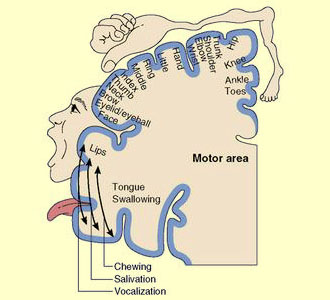
Large parts of our brain are dedicated to the hands, face and mouth. The torso and legs are represented by far smaller parts. This is why the authors claim that the hands are overestimated - because they are over represented in the brain. By this logic, the shoulders, trunk, hips and legs should be underestimated - certainly not overestimated!!! If anything - this research would predict that when a woman thinks about her body she would think that she's smaller than she really is.
Another error in the reporting - they got the name of the lead researcher wrong. This work was conducted by Matthew Longo, not Michael as the papers call him!!!
Monday, 28 June 2010
Vader - BPD or not?
Tuesday, 22 June 2010
Recovering from brain injury...
There's a really interesting piece in the Guardian today about recovery from brain injury.
Subscribe to:
Posts (Atom)